I just stuffed some yarn puke back into the center of a gradient cake. Suddenly the image of stuffing guts back into a sea cucumber popped into my mind. It could have been worse. I could have thought about a Dr. Pol episode.
Saturday, September 4, 2021

Thursday, January 28, 2021
16,222 Projects; 16,191 WIPs
When I go to Ravelry, like most, it is usually to scout out some free patterns. I don't explore outside the Pattern tab very much. Today was an exception. I noticed Friends on the drop down menu. No surprise, I don't have any friends. If I had a friend on Ravelry, that person might be tempted to report me to be kicked off Ravelry. My world view is probably not the sort that the Ravelry admins would like.
On the line menu at the top of the Friends page there was Neighbors. What could that be? Geographical neighbors? It turns out that my Ravelry neighbors are people who have posted projects using the same patterns I used in my posted projects.
My first 'neighbor' had four project patterns in common with me. However, the shocking part was that this person has 16,222 projects, of which only 31 had been completed. That leaves 16,191 Works in Progress. Let that sink in.
I feel guilty if I have six WIPs. Each WIP is in a separate project bag and I've only got so many project bags. If my 'neighbor' had 16,191 project bags, maybe someone on Etsy might be getting rich.
I'm hoping most of the 16,191 WIPs are items that would more properly belong in the Queue menu item. That's where all my aspirational patterns are listed. I currently have two items in my queue. Even having 16,191 items in a queue would seem to display a lack of sorting and prioritization.
Maybe Discovery will come up with a show called My 16K WIPs Life. Sounds kind of kinky when it's put that way.
Sunday, April 26, 2020
Living on Covid Time
Last year I made a Shiri wrap and gave it to my daughter for Christmas. I noticed my mother-in-law having an eye for it and she kept running her hands over it. So I made another one, almost identical that I plan to give her for Mother's Day. I got it off the needles Friday. It took 4 Covid weeks (that means working on it about 10 hours a day because what else have I got to do) to make it.


I blocked it on the kitchen table Saturday. We had to eat our meals at the kitchen counter for a little while.

I took these pictures this morning.
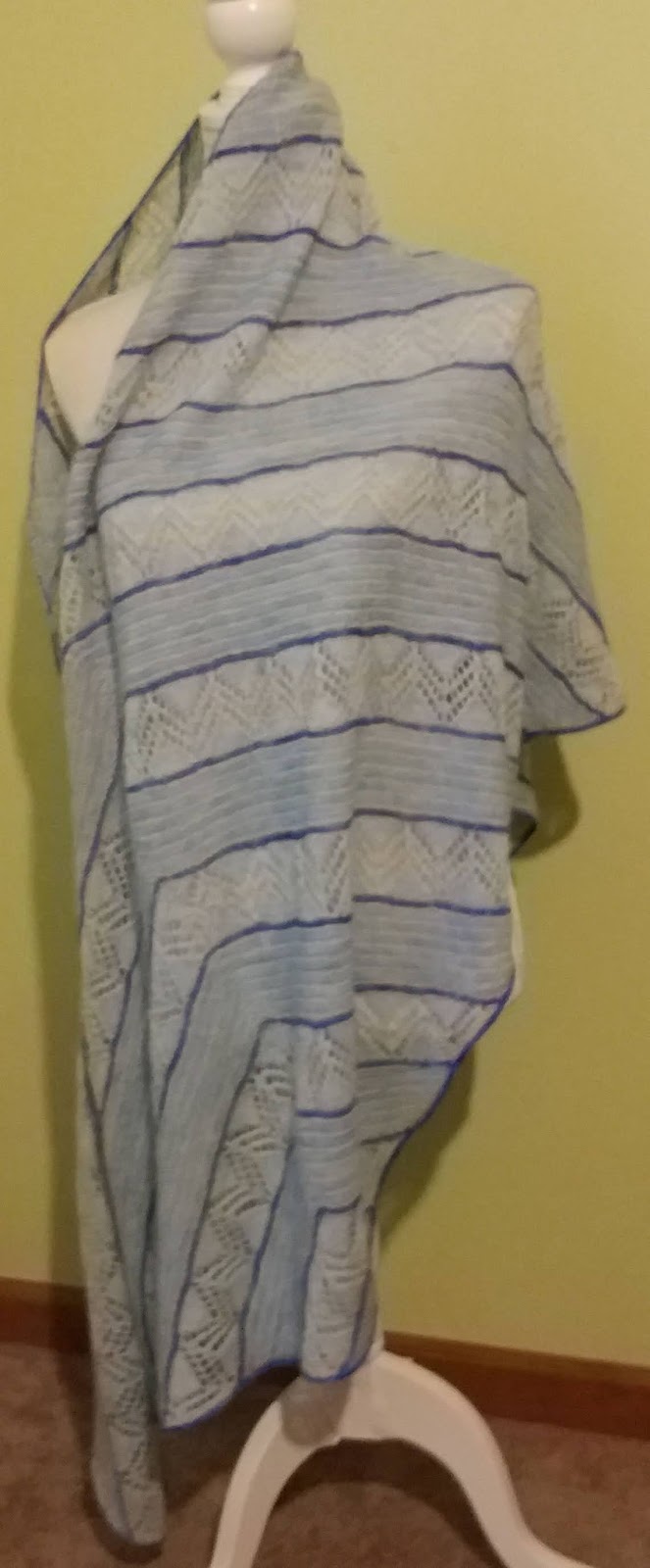
It is 70% alpaca, 20% silk and 10% cashmere. Too bad you can't touch it because it is a wonderful experience.

For those who want the particulars, the pattern can be found at Ravelry.com. It is called Shiri by Ambah O'Bien. The yarn is Winter Light Lace from LuckyVioletColorCo.com.
The yarn was a Christmas present from my son in 2018. When he asked me what I wanted for Christmas I gave him the URL for a page on the Lucky Violet Color Co. web site. The only instruction I gave him was 'no pink.' I did not tell him what yarn base to select.
The Lucky Violet Color Co. has a lot of yarn bases and they dye the yarn to order. My son apparently studied this situation and decided that the best option was to get the most yardage per skein. I think this reasoning process may be an anecdotal example of the difference between the way a non-knitter (especially a guy non-knitter) and a knitter look at this sort of thing. So he picks the Winter Light Lace that is nearly cobweb weight (1300 yards per 100 gram skein). And gets me six skeins, two each of three different blue shades.
I wasn't quite sure what I was going to do with this very light weight yarn. I was a little intimidated. What was I going to do with 4-1/2 miles of light lace weight yarn? I do a lot with fingering weight yarn but I don't venture into the lace weight very often at all. On the bright side, the fiber in this yarn is wonderfully light and soft; he made a great choice in that respect. When I found the Shiri wrap pattern I saw a way out of the predicament. I was able to use two strands together to achieve an ordinary lace weight.
The pattern is not too difficult; a little simple lace alternating with bands of garter stitch. The construction calls for making two identical large triangles. Then the triangles are joined together with a three-needle bind-off. The only challenge is the I-cord border around the whole thing; not because the I-cord is difficult, but because it is a l-o-n-g way around the wrap, like about 1200 stitches. The I-cord method requires working three stitches to bind off one stitch so 3600 stitches to finish the cord edging.
The only problem is that I still have enough yarn to make another one, even after the one I made earlier for my daughter. If I ever send my son to a yarn web site, I'll do a better job with the instructions.
Tuesday, April 14, 2020
Pandemic Memories
The Covid-19 virus (aka Wuhan virus; aka Chinese virus; aka Corona virus; aka CCP virus) pandemic is my fourth pandemic.
1. Asian flu pandemic 1957. Well, I was a toddler so I don't recall so much. Apparently that year measles were a greater threat to me. Measles hospitalized me; I was packed in ice to reduce my temperature.
2. Hong Kong flu pandemic 1967-1968. I remember this one well; I was a teenager. We were on vacation at Carlsbad Caverns. In a crowded cafeteria we shared a table with a woman from the West Coast who was sniffling and snuffling. After we got home we all came down with the flu. It was bad. My Dad took it the worst. He was a three-pack-a-day smoker and he ended up in the hospital with double pneumonia. It damn near killed him. No ventilators then, just an oxygen tent. In the USA 100,000 death were attributed to the Hong Kong flu. There were a million deaths world wide. If they quarantined anyone I never heard of it. Businesses did not close. Life went on. I don't remember any crisis mentality.
3. Swine flu pandemic 2009-2010. I don't recall this Swine flu pandemic nearly as well as I remember the 1976 Swine flu outbreak. I think the press kept the reporting low-key.
4. CCP virus pandemic. Of all the many names for the current pandemic I like CCP pandemic best of all: Chinese Communist Party pandemic. I found that names in the Epoch Times. Because I am retired my life in the 'lock down' is not much different than before. Just glad I live in a rural area where I can go outside and walk around all I want. The biggest differential I have noticed between this pandemic and the earlier pandemics is the damn, awful 24/7 news coverage. So much jabbering from people who have a lot of opinions and not enough facts or good sense. Unfortunately my husband insists on watching one of the business news channels all day long. I expect people discussing business to be rational. Instead there is way too much hair-on-fire disinformation.
Since everyone else is jabbering, here's my bit: I think the lock down has reached the point where the Law of Unintended Consequences is taking over. Those Consequences will soon be more harmful than anything the lock down is intended to prevent. The effects on mental health and the economy are becoming a greater risk to our well being than the virus.
1. Asian flu pandemic 1957. Well, I was a toddler so I don't recall so much. Apparently that year measles were a greater threat to me. Measles hospitalized me; I was packed in ice to reduce my temperature.
2. Hong Kong flu pandemic 1967-1968. I remember this one well; I was a teenager. We were on vacation at Carlsbad Caverns. In a crowded cafeteria we shared a table with a woman from the West Coast who was sniffling and snuffling. After we got home we all came down with the flu. It was bad. My Dad took it the worst. He was a three-pack-a-day smoker and he ended up in the hospital with double pneumonia. It damn near killed him. No ventilators then, just an oxygen tent. In the USA 100,000 death were attributed to the Hong Kong flu. There were a million deaths world wide. If they quarantined anyone I never heard of it. Businesses did not close. Life went on. I don't remember any crisis mentality.
3. Swine flu pandemic 2009-2010. I don't recall this Swine flu pandemic nearly as well as I remember the 1976 Swine flu outbreak. I think the press kept the reporting low-key.
4. CCP virus pandemic. Of all the many names for the current pandemic I like CCP pandemic best of all: Chinese Communist Party pandemic. I found that names in the Epoch Times. Because I am retired my life in the 'lock down' is not much different than before. Just glad I live in a rural area where I can go outside and walk around all I want. The biggest differential I have noticed between this pandemic and the earlier pandemics is the damn, awful 24/7 news coverage. So much jabbering from people who have a lot of opinions and not enough facts or good sense. Unfortunately my husband insists on watching one of the business news channels all day long. I expect people discussing business to be rational. Instead there is way too much hair-on-fire disinformation.
Since everyone else is jabbering, here's my bit: I think the lock down has reached the point where the Law of Unintended Consequences is taking over. Those Consequences will soon be more harmful than anything the lock down is intended to prevent. The effects on mental health and the economy are becoming a greater risk to our well being than the virus.
Friday, March 27, 2020
Google User Interfaces Now In Human Trials
A little over a week ago my laptop computer experienced a disk crash. After a prolonged scan and repair, most of my apps and data were still available. The Start feature did not work and the Search feature in the Task Bar did not work. A couple icons on the Task Bar did not work, returning a "Class not registered" error message.
I ordered a new laptop. While I waited for the new one to arrive, I got along with some work-arounds. Ctrl-Alt-Del got a workout. To open applications I had to use Task Manager\File\Run New Task. That works well if you can remember the application name that the System expects. There was one application, a scanner manager, that I never did figure out, even after a long search of the registry.
Wednesday the new laptop arrived. I was pretty good to myself: 1Tb Solid State Drive and 1Tb conventional hard drive. Plenty of memory. The graphics card is not the very best, maybe in the tier just below because I don't want the kids coveting this laptop for gaming.
I made a mistake during the set up which resulted in my C:\Users account name being different than what it had been on the old machine. Fixing that in the registry took a lot of time because that file path appears in many registry entries. I wish I could have found an easier way to change that. I can't be the first person to have that problem.
I have spent two days migrating into the new machine. I used an external hard drive to move files. I audited the files to ensure the same number of files were on both the old and new machines and in all the same places. Setting up email was not too difficult. I checked and double checked all my connection settings.
Most everything went well until this afternoon when I tried to get into my Google Adsense account. The Google Login security raked me over the coals. Being on a new machine probably raised some flags. It doesn't help that I have two Google accounts; that part of the problem is my fault. I ended up in a loop that started with Google Security wanting to verify my account by re-entering my password. I submitted the password; it gave no indication that there was a problem with the password. It looped me back to the screen where Google Security wanted to verify my account again. And the loop just kept repeating. So I selected the "Forgot Password" option to try to get out of this loop. After I changed the password, it put me through the same verification loop as before.
I futzed around with Google Security for over an hour. If Google Security ever steers you toward an option to use your phone with a screen lock to sign into your account, please, please please don't do it. It just put me into a similar loop and when I found the setting to turn that feature off, Google had warning messages designed to add fear to my loathing. I was so frustrated with all the rigmarole Google was marching me through. Has the testing of Google's Security user interfaces reached the level of human trials? Was I in the human trials? Was someone at Google getting paid to torture me, take notes and laughing about it? I was in such an internal storm that I don't even know what I did to finally get into Adsense.
This was not my first Google goat rodeo; probably won't be my last. I need some wine.
I ordered a new laptop. While I waited for the new one to arrive, I got along with some work-arounds. Ctrl-Alt-Del got a workout. To open applications I had to use Task Manager\File\Run New Task. That works well if you can remember the application name that the System expects. There was one application, a scanner manager, that I never did figure out, even after a long search of the registry.
Wednesday the new laptop arrived. I was pretty good to myself: 1Tb Solid State Drive and 1Tb conventional hard drive. Plenty of memory. The graphics card is not the very best, maybe in the tier just below because I don't want the kids coveting this laptop for gaming.
I made a mistake during the set up which resulted in my C:\Users account name being different than what it had been on the old machine. Fixing that in the registry took a lot of time because that file path appears in many registry entries. I wish I could have found an easier way to change that. I can't be the first person to have that problem.
I have spent two days migrating into the new machine. I used an external hard drive to move files. I audited the files to ensure the same number of files were on both the old and new machines and in all the same places. Setting up email was not too difficult. I checked and double checked all my connection settings.
Most everything went well until this afternoon when I tried to get into my Google Adsense account. The Google Login security raked me over the coals. Being on a new machine probably raised some flags. It doesn't help that I have two Google accounts; that part of the problem is my fault. I ended up in a loop that started with Google Security wanting to verify my account by re-entering my password. I submitted the password; it gave no indication that there was a problem with the password. It looped me back to the screen where Google Security wanted to verify my account again. And the loop just kept repeating. So I selected the "Forgot Password" option to try to get out of this loop. After I changed the password, it put me through the same verification loop as before.
I futzed around with Google Security for over an hour. If Google Security ever steers you toward an option to use your phone with a screen lock to sign into your account, please, please please don't do it. It just put me into a similar loop and when I found the setting to turn that feature off, Google had warning messages designed to add fear to my loathing. I was so frustrated with all the rigmarole Google was marching me through. Has the testing of Google's Security user interfaces reached the level of human trials? Was I in the human trials? Was someone at Google getting paid to torture me, take notes and laughing about it? I was in such an internal storm that I don't even know what I did to finally get into Adsense.
This was not my first Google goat rodeo; probably won't be my last. I need some wine.
Saturday, November 24, 2018
We've Already Postponed Thanksgiving, Can't We Now Just Cancel It?
In preface, this is not a complaint or indictment of Thanksgiving. The Thanksgiving holiday is a fine thing. It's just that mine went all wrong this year.
First, we postponed our observation of Thanksgiving from the usual Thursday to the following Sunday. This was done so we could have a little vacation in New Orleans. It also allowed our kids to take the holiday with the in-laws and the out-laws.
On the Friday before Thanksgiving, the first day of the drive down to New Orleans, I had a bit of a scratchy throat. By the next morning it was a full fledged chest and head cold.
On Sunday Ron wanted to go to the WWII museum. I wanted him to go by himself and let me stay in bed. But he protested that we were on vacation to do things together. Pardon me for saying this but if he actually wanted to do things together he would learn how to knit. I got up and went to the museum. Fortunately, they had wheel chairs available so Ron pushed me all over the place. It's a good museum. You need a full day at least to cover all of it. It's not designed for little kids; I'd say it's best for a 9-10 year old and up. I just wish I had been there on a day when I felt like being alive.
The following day we went to the Audubon Insect Museum and the Audubon Aquarium. Both of these are designed to entertain the smaller children. The Insect Museum has a butterfly garden where you can walk among some exotic butterflies.
I never felt well enough to go out in the evening. Each evening Ron went out and got some rice and beans for me. Good thing I love rice and beans.
On the last full day in New Orleans, Ron said he was getting my cold. We went to the riverfront and took a little cruise on the Natchez.
We drove home on Wednesday, a 12+ hour forced march. The next morning Ron was very ill. He asked me where I got this Black Death of cold. I must of got it somewhere at home or work because I had symptoms well before I got to New Orleans. Today, Saturday, Ron is going to Prompt Care because he has a severe ear ache and is bleeding from his ear.
Fortunately he didn't argue about calling off or further postponing Thanksgiving.
First, we postponed our observation of Thanksgiving from the usual Thursday to the following Sunday. This was done so we could have a little vacation in New Orleans. It also allowed our kids to take the holiday with the in-laws and the out-laws.
On the Friday before Thanksgiving, the first day of the drive down to New Orleans, I had a bit of a scratchy throat. By the next morning it was a full fledged chest and head cold.
On Sunday Ron wanted to go to the WWII museum. I wanted him to go by himself and let me stay in bed. But he protested that we were on vacation to do things together. Pardon me for saying this but if he actually wanted to do things together he would learn how to knit. I got up and went to the museum. Fortunately, they had wheel chairs available so Ron pushed me all over the place. It's a good museum. You need a full day at least to cover all of it. It's not designed for little kids; I'd say it's best for a 9-10 year old and up. I just wish I had been there on a day when I felt like being alive.
The following day we went to the Audubon Insect Museum and the Audubon Aquarium. Both of these are designed to entertain the smaller children. The Insect Museum has a butterfly garden where you can walk among some exotic butterflies.
I never felt well enough to go out in the evening. Each evening Ron went out and got some rice and beans for me. Good thing I love rice and beans.
On the last full day in New Orleans, Ron said he was getting my cold. We went to the riverfront and took a little cruise on the Natchez.
We drove home on Wednesday, a 12+ hour forced march. The next morning Ron was very ill. He asked me where I got this Black Death of cold. I must of got it somewhere at home or work because I had symptoms well before I got to New Orleans. Today, Saturday, Ron is going to Prompt Care because he has a severe ear ache and is bleeding from his ear.
Fortunately he didn't argue about calling off or further postponing Thanksgiving.
Friday, August 4, 2017
Friday, November 25, 2016
Denial
Dad once said that he would not want to live his life over because it had been too hard. There is one part of my life that I wish I could live over: the last six months of my mother’s life.
My Mom started to die the day Clinton won the election in 1992. Dad was pissed off about Clinton winning and he apparently took it out on Mom. The stress resulted in her having a gall bladder attack. The operation for the gall bladder damn near killed her.
It should have been a routine procedure. A doctor who had done it many times before should have performed it. Instead, she went to the family doctor. The family doctor had just completed a training course in using a laser scope method to remove the gall bladder. It sounded good. Three little incisions and Mom would be out of the hospital in two days.
It appeared to work but a week after the operation Mom was in intensive care. The family doctor accidentally nicked the bile duct during the operation. Bile fluid leaked into Mom’s abdominal cavity. It literally started digesting her from the inside out. Her liver, intestine and pancreas had all suffered damage. There was a major operation to correct the problems from the first operation. Mom stayed in ICU for a week.
Even when she came home, she had a drain still in place, hanging out of her side. A home-care nurse visited her to attend to the drain. It was a year before Mom got back to normal. But it was never really normal. She lost something. There were the things she did before the operation and then there was a different set of things she did a year later.
Before the operation Mom and Dad went on bus tours with other senior citizens. After the operation Mom had little energy for trips. Before the operation my mother had a slightly stooped posture. Years of bending herself over a sewing machine accounted for her stoop. But after the operation, the stoop was a clear dowagers hump. Raising her hands over her head was painful and finally not possible.
Mom and Dad saw a lawyer about suing the family doctor. Mom was not cut out for her role in a lawsuit. She did not have the spirit of the thing. All she wanted to sue for was the cost of the second operation. She thought that Medicare ought to be paid back for the $30,000 cost of the second operation. She wasn’t interested in any other damages. The lawyer firm turned her away. She did not seek a second opinion. It’s just as well. Mom would have made a lousy witness. She would have apologized for getting sick in the first place. After all, the doctor would have never screwed up the operation if she had not been there. Perhaps the lawyers sensed that about her character. I bet the lawyers thought she was nuts.
After Mom died Dad often spoke about how many things he didn’t know about her. “I never even knew who she voted for.” Huh? Who cares whom she voted for? What has that got to do with knowing her?
It makes sense now. In 1992, the day after Clinton won, Dad probably wanted to know whom she voted for. Perhaps he imagined that she voted for Clinton. He gave himself permission to treat her like dirt. Dad was not a beater; he was a verbal abuser. I expect he said some awful things to her.
The stress had stirred up the gall bladder attack. It was 9 more years before she died.
I never had a good talk with Mom. She did not invite conversation. She was about work. There was always sewing, quilting and mending; but only if all the sweeping, scrubbing and vacuuming was done. Her home was humble, orderly and clean. I must have been a frightful disappointment to her.
I never learned how to sew very well; I was never orderly and I approach clean as a relative thing. She must have wondered whom she pissed off to end up with a daughter like me.
And so we continued for 47 years conversing in only the most functional manner. If I had been interested in quilting and sewing we might have been close. I did like to knit but unfortunately I am a process knitter. I only care about the mathematics of knitting. I don’t care if I end up with something useful. This did not make sense to Mom. Every time she saw me ripping out something I had just knitted, she would look sort of sad and perplexed.
Before Mom’s gall bladder operation, she could work me into the ground.
When she came to visit me, we never sat down to have a conversation.
The minute she got in the door, she started looking for something to clean.
At my house you didn’t have to look hard to find something that needs cleaning and straightening. And so Mom would attack it. She always had a place for me in her vision of what needed to be done. She never ordered me to participate in her projects at my house, but how could I sit while she slaved?. She wore me out. The moment she left, I headed straight to bed. My husband said we should have her visit more often; he liked the results. My kids undid her good works in a few hours. After the operation she still tried to work, but there were many things she could not do. She could fold laundry almost to the end.
The summer before she died Mom and Dad had problems with their central air conditioner. The central air system was not well engineered. The part that broke was up in the attic crawl space.
To fix it required going into the crawl space that was over 120º F. No workman wanted any part of it. The air conditioning still cooled the bedrooms, but the kitchen and living room were too warm to stay in for long. Mom had been very frail for the last year. She had a couple ‘episodes’ of fainting.
The air conditioner problem confined her to the bedroom. Dad put up a card table in the bedroom for Mom to eat at. Dad put a portable commode next to the bed. Mom was marooned. Her back was in pain much of the time.
Dad started talking about putting Mom in a nursing home. He didn’t know how to deal with her when she had an episode. Her condition scared him. I didn’t understand why he wanted to put her in a home. What I didn’t realize until later was that Mom was putting on a good show when I was there. Dad had to deal with a truth I never saw.
In late August Mom went into the nursing home. I still believed that the air conditioner problem had just stressed her out. She would get some rest and be home soon. After she had been there for a few weeks, I remember visiting her on a Saturday morning. When I walked in the room she said, “I can’t walk anymore”
“What do you mean?”
“I can’t control my legs anymore. They won’t go were I put them. They want to cross over each other.”
I had trouble taking it all in.
Denial.
My mother never exposed her emotions. I never saw my mother cry. Now, even her subdued presentation showed how dismal she felt. Then Dad came in the room. He told me how Mom’s legs had collapsed from under her a few days earlier when he was helping her to walk to the bathroom.
It had taken several attendants to get her off the bathroom floor.
She would never walk again.
There were subtle things going on during those early weeks in the nursing home; things I did not grasp or understand until much later. I missed a great and important opportunity. In the next few months Mom lost the ability to communicate. First she couldn’t make sentences; then she couldn’t make words. But that day when she told me she could not walk, I missed the opportunity to talk to her. There she was finally unable to work. For the next month she was still able to talk. But I wasn’t there for her. I came on weekends only. I didn’t stay long enough.
I failed her.
My Mom started to die the day Clinton won the election in 1992. Dad was pissed off about Clinton winning and he apparently took it out on Mom. The stress resulted in her having a gall bladder attack. The operation for the gall bladder damn near killed her.
It should have been a routine procedure. A doctor who had done it many times before should have performed it. Instead, she went to the family doctor. The family doctor had just completed a training course in using a laser scope method to remove the gall bladder. It sounded good. Three little incisions and Mom would be out of the hospital in two days.
It appeared to work but a week after the operation Mom was in intensive care. The family doctor accidentally nicked the bile duct during the operation. Bile fluid leaked into Mom’s abdominal cavity. It literally started digesting her from the inside out. Her liver, intestine and pancreas had all suffered damage. There was a major operation to correct the problems from the first operation. Mom stayed in ICU for a week.
Even when she came home, she had a drain still in place, hanging out of her side. A home-care nurse visited her to attend to the drain. It was a year before Mom got back to normal. But it was never really normal. She lost something. There were the things she did before the operation and then there was a different set of things she did a year later.
Before the operation Mom and Dad went on bus tours with other senior citizens. After the operation Mom had little energy for trips. Before the operation my mother had a slightly stooped posture. Years of bending herself over a sewing machine accounted for her stoop. But after the operation, the stoop was a clear dowagers hump. Raising her hands over her head was painful and finally not possible.
Mom and Dad saw a lawyer about suing the family doctor. Mom was not cut out for her role in a lawsuit. She did not have the spirit of the thing. All she wanted to sue for was the cost of the second operation. She thought that Medicare ought to be paid back for the $30,000 cost of the second operation. She wasn’t interested in any other damages. The lawyer firm turned her away. She did not seek a second opinion. It’s just as well. Mom would have made a lousy witness. She would have apologized for getting sick in the first place. After all, the doctor would have never screwed up the operation if she had not been there. Perhaps the lawyers sensed that about her character. I bet the lawyers thought she was nuts.
After Mom died Dad often spoke about how many things he didn’t know about her. “I never even knew who she voted for.” Huh? Who cares whom she voted for? What has that got to do with knowing her?
It makes sense now. In 1992, the day after Clinton won, Dad probably wanted to know whom she voted for. Perhaps he imagined that she voted for Clinton. He gave himself permission to treat her like dirt. Dad was not a beater; he was a verbal abuser. I expect he said some awful things to her.
The stress had stirred up the gall bladder attack. It was 9 more years before she died.
I never had a good talk with Mom. She did not invite conversation. She was about work. There was always sewing, quilting and mending; but only if all the sweeping, scrubbing and vacuuming was done. Her home was humble, orderly and clean. I must have been a frightful disappointment to her.
I never learned how to sew very well; I was never orderly and I approach clean as a relative thing. She must have wondered whom she pissed off to end up with a daughter like me.
And so we continued for 47 years conversing in only the most functional manner. If I had been interested in quilting and sewing we might have been close. I did like to knit but unfortunately I am a process knitter. I only care about the mathematics of knitting. I don’t care if I end up with something useful. This did not make sense to Mom. Every time she saw me ripping out something I had just knitted, she would look sort of sad and perplexed.
Before Mom’s gall bladder operation, she could work me into the ground.
When she came to visit me, we never sat down to have a conversation.
The minute she got in the door, she started looking for something to clean.
At my house you didn’t have to look hard to find something that needs cleaning and straightening. And so Mom would attack it. She always had a place for me in her vision of what needed to be done. She never ordered me to participate in her projects at my house, but how could I sit while she slaved?. She wore me out. The moment she left, I headed straight to bed. My husband said we should have her visit more often; he liked the results. My kids undid her good works in a few hours. After the operation she still tried to work, but there were many things she could not do. She could fold laundry almost to the end.
The summer before she died Mom and Dad had problems with their central air conditioner. The central air system was not well engineered. The part that broke was up in the attic crawl space.
To fix it required going into the crawl space that was over 120º F. No workman wanted any part of it. The air conditioning still cooled the bedrooms, but the kitchen and living room were too warm to stay in for long. Mom had been very frail for the last year. She had a couple ‘episodes’ of fainting.
The air conditioner problem confined her to the bedroom. Dad put up a card table in the bedroom for Mom to eat at. Dad put a portable commode next to the bed. Mom was marooned. Her back was in pain much of the time.
Dad started talking about putting Mom in a nursing home. He didn’t know how to deal with her when she had an episode. Her condition scared him. I didn’t understand why he wanted to put her in a home. What I didn’t realize until later was that Mom was putting on a good show when I was there. Dad had to deal with a truth I never saw.
In late August Mom went into the nursing home. I still believed that the air conditioner problem had just stressed her out. She would get some rest and be home soon. After she had been there for a few weeks, I remember visiting her on a Saturday morning. When I walked in the room she said, “I can’t walk anymore”
“What do you mean?”
“I can’t control my legs anymore. They won’t go were I put them. They want to cross over each other.”
I had trouble taking it all in.
Denial.
My mother never exposed her emotions. I never saw my mother cry. Now, even her subdued presentation showed how dismal she felt. Then Dad came in the room. He told me how Mom’s legs had collapsed from under her a few days earlier when he was helping her to walk to the bathroom.
It had taken several attendants to get her off the bathroom floor.
She would never walk again.
There were subtle things going on during those early weeks in the nursing home; things I did not grasp or understand until much later. I missed a great and important opportunity. In the next few months Mom lost the ability to communicate. First she couldn’t make sentences; then she couldn’t make words. But that day when she told me she could not walk, I missed the opportunity to talk to her. There she was finally unable to work. For the next month she was still able to talk. But I wasn’t there for her. I came on weekends only. I didn’t stay long enough.
I failed her.
Thursday, June 26, 2014
Ugly Christmas Sweater
Last Christmas the office where my husband works had an ugly Christmas sweater contest. My husband was not part of that contest. He expressed interest in doing it next year. So I told him I would make an ugly Christmas sweater. Let's face it, any excuse to buy more yarn is a good excuse to buy more yarn.
I'm using the Sweater Wheel to generate a pattern - set-in sleeve, pullover. I'm starting on the front of the sweater. Not sure what I'll do on the back. Do Christmas sweaters have to be decorated on both sides? Is there an International Ugly Christmas Sweater Society that has promulgated the rules and regulations for ugly Christmas sweaters? If not, can I start one? Where do all the ugly Christmas sweaters come from? Is there a prison in China where all the inmates are slaves to the production of ugly Christmas sweaters? Who designs these hideous creations? Is the compulsive designing of ugly Christmas sweaters a condition that has its own DSM-IV-TR Code for Psychiatric Illness? I may need to know that before I complete this project. Are there dark forces now poised to unleash a legion of ugly Halloween sweaters? -- I've already seen a few.
But I digress [whenever possible].
I'm going for a Christmas tree theme. After starting off with a couple inches of ribbing, I made 8 blocks of different colors in two different sizes alternating. These are going to be the presents under the tree. Before it is over they will be dressed up with ribbons. The tree is developing from a stack of trapezoids that are smaller as I go up the tree. The lower edge of the trapezoid is adorned with the Three Flowers pattern to emulate strings of lights. There is plenty of space left on each trapezoid to tack on ornaments that I plan to make later from my novelty yarn remnants stash.
This is a picture of what I've done so far:

I'm using the Sweater Wheel to generate a pattern - set-in sleeve, pullover. I'm starting on the front of the sweater. Not sure what I'll do on the back. Do Christmas sweaters have to be decorated on both sides? Is there an International Ugly Christmas Sweater Society that has promulgated the rules and regulations for ugly Christmas sweaters? If not, can I start one? Where do all the ugly Christmas sweaters come from? Is there a prison in China where all the inmates are slaves to the production of ugly Christmas sweaters? Who designs these hideous creations? Is the compulsive designing of ugly Christmas sweaters a condition that has its own DSM-IV-TR Code for Psychiatric Illness? I may need to know that before I complete this project. Are there dark forces now poised to unleash a legion of ugly Halloween sweaters? -- I've already seen a few.
But I digress [whenever possible].
I'm going for a Christmas tree theme. After starting off with a couple inches of ribbing, I made 8 blocks of different colors in two different sizes alternating. These are going to be the presents under the tree. Before it is over they will be dressed up with ribbons. The tree is developing from a stack of trapezoids that are smaller as I go up the tree. The lower edge of the trapezoid is adorned with the Three Flowers pattern to emulate strings of lights. There is plenty of space left on each trapezoid to tack on ornaments that I plan to make later from my novelty yarn remnants stash.
This is a picture of what I've done so far:
Tuesday, January 15, 2013
Lace Patterns That Don't Seem To Work Out Right
I had an email yesterday from someone who thought that the Coral stitch pattern had an error on Rows 2 and 6. Specifically the writer indicated the following:
CORAL
SAYS 10 PLUS 1 ST
ROW 2, 6 IS 10 PLUS 4 STS ALSO ON ROW 6 YOU ARE DECREASING 4 STITCHES
BUT ONLY ADDING 2 YO"
I think the problem is a matter of knowing how to read lace patterns.
In lace patterns there are often ‘shared’ elements that have to split when the edge of the fabric is reached. Row 2 of Coral ends with a k2 INSTEAD of a k3. In row 2 of the chart you see three knit stitches in the center framed by an ssk on one side and a k2-tog on the other side – the center stitch of those three knit stitches is ‘shared’ between pattern repeats. At the edge of the fabric these three stitches --must be ‘split’ to maintain the symmetry of the fabric. That is done by adding the +1 stitch and then splitting it into a k2 on either edge of the fabric.

Similarly, on Row 6 the sl 1-k2-tog-psso has to be split at the outer edge of the fabric. Again the +1 stitch allows the sl 1-k2-tog-psso to be split into a k2-tog at the beginning of the row and an ssk INSTEAD of the sl 1-k2-tog-psso in the last repeat. The shared elements are more easy to identify when a pattern is charted. When knitting from a written lace pattern, you may often have to just accept the instructions that tell you how to force the ending at the fabric edge on the last repeat. Whenever I see a double decrease converted to a single decrease at the end of a lace pattern, I know the instructions are just telling me to work ‘half’ of the double decrease to keep the fabric even.
Sunday, August 12, 2012
Fishing and Knitting
I just returned home from Stitches Midwest in Schaumburg, Illinois. Very good show; the biggest and best I've been to and I've been attending for at least 6 years.
When I was packing last week, my husband asked me if I was taking half the house.
"I'm only taking my knitting hardware."
Later it occurred to me how a woman might explain her collection of knitting gear to her husband: It's like fishing tackle.
Both fishing hardware and knitting hardware are accumulated over a long time. Additions to both are made for special "catches." Every different type or location of fishing requires the acquisition of different tackle. That cane pole you started out with will not catch sea bass.
Likewise, different styles of knitting and different garments require different tools. Six-inch double point needles work well for socks but you probably need something more robust for a shawl.
Sometimes a fishing lure is purchased just because it looks kind of cool. There is a lot of eye candy in the hard-bait lure aisle at Bass Pro Shops. Or maybe you just like to collect new tools of the trade.
How many knitting tools have I purchased, not for an immediate need or a current plan, but just because of the "pretty bobble" factor. I have lots of stitch markers that are just fascinating to look at but, in any practical sense, I'm not likely to use them. They are my "bling-things." I sometimes buy needles just because they are different from any I already have. It's the collecting bug.
When you plan a fishing trip to some other state or region, there is a tendency to want to take too much tackle with you because you just never know what kind of fishing opportunity or location you may find. What will the fish be biting on this morning?
When I leave the house to drive several hours to Stitches Midwest I have an urge to take every last needle and knitting widget I've ever owned because I'm never 100% sure what I will need. In other words: Back up the truck!
The analogy between fishing and knitting could go on, like both take lots of patience. You get the idea.
When I was packing last week, my husband asked me if I was taking half the house.
"I'm only taking my knitting hardware."
Later it occurred to me how a woman might explain her collection of knitting gear to her husband: It's like fishing tackle.
Both fishing hardware and knitting hardware are accumulated over a long time. Additions to both are made for special "catches." Every different type or location of fishing requires the acquisition of different tackle. That cane pole you started out with will not catch sea bass.
Likewise, different styles of knitting and different garments require different tools. Six-inch double point needles work well for socks but you probably need something more robust for a shawl.
Sometimes a fishing lure is purchased just because it looks kind of cool. There is a lot of eye candy in the hard-bait lure aisle at Bass Pro Shops. Or maybe you just like to collect new tools of the trade.
How many knitting tools have I purchased, not for an immediate need or a current plan, but just because of the "pretty bobble" factor. I have lots of stitch markers that are just fascinating to look at but, in any practical sense, I'm not likely to use them. They are my "bling-things." I sometimes buy needles just because they are different from any I already have. It's the collecting bug.
When you plan a fishing trip to some other state or region, there is a tendency to want to take too much tackle with you because you just never know what kind of fishing opportunity or location you may find. What will the fish be biting on this morning?
When I leave the house to drive several hours to Stitches Midwest I have an urge to take every last needle and knitting widget I've ever owned because I'm never 100% sure what I will need. In other words: Back up the truck!
The analogy between fishing and knitting could go on, like both take lots of patience. You get the idea.
Sunday, March 25, 2012
How to Get a Picture of a Knitting Swatch
I am camera illiterate and not likely to improve soon. My husband is very good with a camera. Unfortunately every time he sees me with a camera he assumes I want his help. If I let him help, he starts barking advice at me and peppering me rapid-fire with a lot of terminology that does little to alleviate my confusion. I need a better teacher.
So -- how to get pictures of knitting swatches for my web site without making myself a target for my husband's hectoring? Enter my cheap little HP printer scanner and a few items from the craft shop. I use a 1.5" thick slab of Styrofoam and a thin sheet of black craft foam as a foundation for pinning out my swatches. The Styrofoam came wrapped in a thin, clear shrink wrap of plastic. I have never removed that plastic so that I never have little bits of Styrofoam rubbing off the slab. I anchored the craft foam to the Styrofoam with four, t-top, blocking pins. I used a straight-edge to score barely visible, 1" grid lines on the craft foam. That grid helps when pinning a swatch out on the block. I use the same blocking pins when mounting swatches on the block. I have been using this method the six or seven years and I have only replace the Styrofoam slab once.
Once the swatch is mounted, I put the block, swatch side down on my scanner. I run through the dialog boxes in the HP user interface. I do a little manipulation of the scanned image in the HP environment. Then I save it to a relatively high resolution .JPEG file. This initial file still shows all my blocking pins.
Next I open the file in a photo editor. My photo editor is Corel PaintShop Pro X4, however, there are many other photo editors applications that will allow for trimming and resizing an image.
The first action I take is to correct the alignment of the image. Although the grid lines on the craft foam help, I usually need to rotate the image a few degrees to the right or left.
The second action I take is to crop out the best part of the image. I copy this part out to a new .JPEG file. This will be the view of the swatch that I put on the web site.
The third step is to resize the image for the web. I try to resize the image so that its size is less than 45 kilobytes (Kb). It is important to keep the size of images on the web small. Even 45 Kb is a bit risky. But if there are not a lot of images on a page 45 Kb is probably within reason. I save this reduced size image into my pictures directory.
Then for my last step I create an even more reduced size copy of the file. This much reduced image is the thumbnail. If you are familiar with my web site, I use a lot of these small images. The thumbnail should be as small as is possible without making the little image a complete blur -- 4Kb is a good target for the thumbnail size, but you may have play with this to get a balance between size and visibility. This small image make it reasonable to have many images on a page without making the page very slow to load. I save this small image into my thumbs directory.
There are swatches that do not lend themselves to the scanner treatment. Bobbles and over sized swatches don't go well on the scanner. For those I put myself back on the mercies of my husband and his camera.
So -- how to get pictures of knitting swatches for my web site without making myself a target for my husband's hectoring? Enter my cheap little HP printer scanner and a few items from the craft shop. I use a 1.5" thick slab of Styrofoam and a thin sheet of black craft foam as a foundation for pinning out my swatches. The Styrofoam came wrapped in a thin, clear shrink wrap of plastic. I have never removed that plastic so that I never have little bits of Styrofoam rubbing off the slab. I anchored the craft foam to the Styrofoam with four, t-top, blocking pins. I used a straight-edge to score barely visible, 1" grid lines on the craft foam. That grid helps when pinning a swatch out on the block. I use the same blocking pins when mounting swatches on the block. I have been using this method the six or seven years and I have only replace the Styrofoam slab once.
Once the swatch is mounted, I put the block, swatch side down on my scanner. I run through the dialog boxes in the HP user interface. I do a little manipulation of the scanned image in the HP environment. Then I save it to a relatively high resolution .JPEG file. This initial file still shows all my blocking pins.
Next I open the file in a photo editor. My photo editor is Corel PaintShop Pro X4, however, there are many other photo editors applications that will allow for trimming and resizing an image.
The first action I take is to correct the alignment of the image. Although the grid lines on the craft foam help, I usually need to rotate the image a few degrees to the right or left.
The second action I take is to crop out the best part of the image. I copy this part out to a new .JPEG file. This will be the view of the swatch that I put on the web site.
The third step is to resize the image for the web. I try to resize the image so that its size is less than 45 kilobytes (Kb). It is important to keep the size of images on the web small. Even 45 Kb is a bit risky. But if there are not a lot of images on a page 45 Kb is probably within reason. I save this reduced size image into my pictures directory.
Then for my last step I create an even more reduced size copy of the file. This much reduced image is the thumbnail. If you are familiar with my web site, I use a lot of these small images. The thumbnail should be as small as is possible without making the little image a complete blur -- 4Kb is a good target for the thumbnail size, but you may have play with this to get a balance between size and visibility. This small image make it reasonable to have many images on a page without making the page very slow to load. I save this small image into my thumbs directory.
There are swatches that do not lend themselves to the scanner treatment. Bobbles and over sized swatches don't go well on the scanner. For those I put myself back on the mercies of my husband and his camera.
Saturday, March 3, 2012
Knitting Abbreviations and Other Stuff
I have been reorganizing my on-line collection of knitting abbreviations and terms. This has caused me to remember a time when I took a technical writing class. I took the class only because it met a graduation requirement and it was a substitute for the more conventional English Writing class that most under graduates have to take. I was ideologically at odds with all my high school English teachers, and even to this day I have not met an English teacher whom I considered entirely worthy of oxygen.
I could tell some stories about my war with English teachers including an essay I wrote for an ultra-pacifist, gun-hating English teacher about the beauty of 12-gauge shotgun shells. If you are an English teacher take comfort in the knowledge that I am actively trying to avoid you and, oh by the way, sucks to be you.
At this point any English teacher will be fighting the urge to scrawl a great, red "F" on this blog and report me to the principal for . . . what? As you can see, it was imperative that I sign up for the technical writing class to avoid the dreaded English teacher. The technical writing class was taught by a Communication graduate student instead of someone from the English department, a slight improvement.
In the first class, the instructor presented the class with several examples of badly written instructions. Lo and behold, she gave her worst marks to a crocheted doily pattern from a 1950's booklet. She went on in detail about how incomprehensible it was. And then to make her point, the little darling put it on my desk and ask me if I didn't agree. I just started reading it off to her, not as the literal abbreviations on the page, but rather, in its long-hand, translated version. Shut her up! She didn't know my Mother owned a copy of the same booklet and I had already made the one she singled out for criticism.
This all occurred decades ago before computers were common place. Since then I realize that crochet pattern was not an ordinary set of instructions. It was more like a computer program. In fact, syntactically, it was closer to a low-level programming language such as machine code or assembler language. Knitting patterns for lace doilies are similar in construction to the crocheted doily patterns. The patterns are the code and the knitter or crocheter is the computer central processing unit.
The technical writing class was not exactly enjoyable, but I probably enjoyed it more than the rest of the class. I have a perverse affinity for tedious, mind-numbing, excessively linear processes. And that explains why I would spend days trying to find a better database structure and web page interface to store my collection of knitting terms and abbreviations. It will always be a work in progress with pauses.
Meanwhile I am already penciling together some ideas for a better way to store and display my knitting symbols collection. I'm trying to figure out something for knitting symbols that would be like Mendeleev's Periodic Table of Elements. I don't think I can make anything that elegant. Mendeleev had a distinct advantage because unlike knitting stitches, the elements were created by God, therefore Mendeleev's work has the strength of Natural Law to give it order.
I could tell some stories about my war with English teachers including an essay I wrote for an ultra-pacifist, gun-hating English teacher about the beauty of 12-gauge shotgun shells. If you are an English teacher take comfort in the knowledge that I am actively trying to avoid you and, oh by the way, sucks to be you.
At this point any English teacher will be fighting the urge to scrawl a great, red "F" on this blog and report me to the principal for . . . what? As you can see, it was imperative that I sign up for the technical writing class to avoid the dreaded English teacher. The technical writing class was taught by a Communication graduate student instead of someone from the English department, a slight improvement.
In the first class, the instructor presented the class with several examples of badly written instructions. Lo and behold, she gave her worst marks to a crocheted doily pattern from a 1950's booklet. She went on in detail about how incomprehensible it was. And then to make her point, the little darling put it on my desk and ask me if I didn't agree. I just started reading it off to her, not as the literal abbreviations on the page, but rather, in its long-hand, translated version. Shut her up! She didn't know my Mother owned a copy of the same booklet and I had already made the one she singled out for criticism.
This all occurred decades ago before computers were common place. Since then I realize that crochet pattern was not an ordinary set of instructions. It was more like a computer program. In fact, syntactically, it was closer to a low-level programming language such as machine code or assembler language. Knitting patterns for lace doilies are similar in construction to the crocheted doily patterns. The patterns are the code and the knitter or crocheter is the computer central processing unit.
The technical writing class was not exactly enjoyable, but I probably enjoyed it more than the rest of the class. I have a perverse affinity for tedious, mind-numbing, excessively linear processes. And that explains why I would spend days trying to find a better database structure and web page interface to store my collection of knitting terms and abbreviations. It will always be a work in progress with pauses.
Meanwhile I am already penciling together some ideas for a better way to store and display my knitting symbols collection. I'm trying to figure out something for knitting symbols that would be like Mendeleev's Periodic Table of Elements. I don't think I can make anything that elegant. Mendeleev had a distinct advantage because unlike knitting stitches, the elements were created by God, therefore Mendeleev's work has the strength of Natural Law to give it order.
Sunday, November 14, 2010
Paused the Goal
For the last several years one of my goals has been to work a new swatch every day and add its picture to the KnittingFool web site. There have been times when I fell off the goal, like last year when my Dad died. And this week when my daughter asked me to make a sweater for her; a particular sweater she saw at Knitter's Midwest last August. She remembered that it was announced during the runway fashion show that the pattern would be in the Knitter's 100th issue. So when that issue came recently she found the pattern for the Celebrate Tunic and wanted me to make it.
I ordered the yarn, Cascade 220 Superwash, from YarnCountry.com on Saturday 11/13/2010. They had almost all of the 11 rainbow colors; we found close substitutes for a couple colors. The yarn arrived the following Monday. I wasn't expecting it that fast. I worked my guage swatch Monday evening and started the front of the sweater that evening. It is now the following Sunday and I just finished the second sleeve -- all the knitting is done. I'm going to take a break for a couple days before I block and finish the sweater.
My daughter should have made the sweater because the pattern is so simple -- all garter stitch and simple shaping. But the yarn was a bit more expensive than what she is accustomed to working with, and she does not have a good completion record, so she was intimidated by it.
I understand how that is. I made my first sweater at about her age. I made it out of Red Heart wool in a varigated shade of olive greens. I had to use the varigated yarn because my Mom would not front the money to buy all the yarn at one time -- varigated yarn reduced the risk of having a mixed dye lot. My weekly allowance was enough to buy two skeins. It took about six weeks to get all the yarn, two skeins at a time. It was a great sweater, a pattern from a woman's magazine (McCall's or Good Housekeeping), long cardigan, simple 7 stitch cables all over (with the purl stitch down the middle) and set in pockets. Fairly challenging for a first time sweater but I was so determined to show my Mom that I was not a bad bet. She was a little easier about financing my early projects after that.
So for a week I have not added any swatch pictures to KnittingFool. I will try to catch it up a bit over the Thanksgiving weekend. Hope you understand.
I ordered the yarn, Cascade 220 Superwash, from YarnCountry.com on Saturday 11/13/2010. They had almost all of the 11 rainbow colors; we found close substitutes for a couple colors. The yarn arrived the following Monday. I wasn't expecting it that fast. I worked my guage swatch Monday evening and started the front of the sweater that evening. It is now the following Sunday and I just finished the second sleeve -- all the knitting is done. I'm going to take a break for a couple days before I block and finish the sweater.
My daughter should have made the sweater because the pattern is so simple -- all garter stitch and simple shaping. But the yarn was a bit more expensive than what she is accustomed to working with, and she does not have a good completion record, so she was intimidated by it.
I understand how that is. I made my first sweater at about her age. I made it out of Red Heart wool in a varigated shade of olive greens. I had to use the varigated yarn because my Mom would not front the money to buy all the yarn at one time -- varigated yarn reduced the risk of having a mixed dye lot. My weekly allowance was enough to buy two skeins. It took about six weeks to get all the yarn, two skeins at a time. It was a great sweater, a pattern from a woman's magazine (McCall's or Good Housekeeping), long cardigan, simple 7 stitch cables all over (with the purl stitch down the middle) and set in pockets. Fairly challenging for a first time sweater but I was so determined to show my Mom that I was not a bad bet. She was a little easier about financing my early projects after that.
So for a week I have not added any swatch pictures to KnittingFool. I will try to catch it up a bit over the Thanksgiving weekend. Hope you understand.
Sunday, October 24, 2010
Knitting the Lorenz Manifold
A few years ago I came across a pattern to crochet the Lorenz Manifold. The crochet pattern was not like any others I had seen, perhaps because it was created by someone who had their mind way into math. Just a sample:
"rnd 4: 60 dtr 0 3 4 7 8 11 12 15 16 19 20 23 24 27 28 31 32 35 36 39 (gd 12.75)"
The short intrepretation: You will end round 3 with 60 dtr (double triple) crochets on the round. you will achieve this be working two dtr in each stitch of the previous row shown in the list. That means that starting with the 0 stitch (the first stitch to a non-mathematician) you will work two dtr in the first stitch, one dtr in each of the 2nd and 3rd stitches, two dtr in each of the 4th and 5th stitches (on the list as 3 and 4) and so on. The gd 12.75 is a measurement of geodesic distance. According to the pattern the gd is given for "orientation and motivation" -- yeah, right, motivation.
One other little note: dtr is double triple crochet. But the pattern is from the UK where double triple crochet means the same as triple crochet in the US.
It took me a while to convert this into a knit pattern. And what I have is still a draft. I am working through it for the second time. The first time I used knitting worsted. I did all the increases as "work two stitches in one stitch." Because of the bulk of the knitting worsted the result was heavy and difficult to mount on a frame. This time I am working all the increases as yarn overs and I am using lace weight yarn
Abbreviations:
K = knit a stitch
YO=yarn over
K2 = knit the next two stitches
Kn = knit the next n stitches
M= make one; knit into the front and back of the stitch. This is an increase of one stitch.
D=decrease one stitch
DM=knit two stitches together and before removing the loops from the needle, K1-b in the same two stitches.
Work even the same as knit around.
Cast on 5 stitches. Join into a ring being careful not to twist the stitches.
Row 1. M in each stitch. (total of 10 stitches)
Row 2. M in each stitch. (total of 20 stitches)
Row 3 work even
Row 4. M in each stitch. (total of 40 stitches)
Row 5 work even
Row 6 work even
Row 7. YO, k1, [K2, (YO, k1) twice] 9 times, K2, YO, k1. (total of 60 stitches)
Row 8 work even
Row 9 work even
Row 10 YO, k1, [K4, (YO, k1) twice] 9 times, K4, YO, k1. (total of 80 stitches
Row 11 work even
Row 12 work even
Row 13. K3, [(YO, k1) twice, K6] 9 times, (YO, k1) twice, K3. (total of 100 stitches)
Row 14 work even
Row 15 work even
Row 16. YO, k1, [K8, (YO, k1) twice] 9 times, K8, YO, k1. (total of 120 stitches)
Row 17 work even
Row 18 work even
Row 19. K111, YO, K5, YO, K4. (total of 122 stitches)
Row 20 work even
Row 21 work even
Row 22. YO, K3, YO, K5, YO, K3, (YO, k1) twice, K2, YO, K5, YO, k1, [K6, YO, K5, YO, k1] 6 times, K2, (YO, k1) twice, K2, YO, K5, YO, K3, (YO, k1) twice, K12, YO, k1. (total of 148 stitches)
Row 23 work even
Row 24 work even
Row 25. K7, (YO, k1) twice, K21, [(YO, k1) twice, K12] 5 times, (YO, k1) twice, K6, YO, K15, (YO, k1) twice, K10, YO, K3, (YO, k1) 4times, K2, YO, k4. (total of 171 stitches)
Row 26 work even
Row 27 work even
Row 28. K3, YO, K3, YO, K19, [(YO, k1) twice, K14] 6 times, YO, K16, YO, K5, YO, K3, YO, k26. (total of 189 stitches)
Row 29 work even
Row 30. K13, YO, K3, YO, k2 132, YO, k40. (total of 192 stitches)
Row 31 work even
Row 32. YO, K25, YO, K3, YO, K5, YO, K3, YO, K10, YO, K5, YO, K67, YO, K5, YO, K10, YO, K3, YO, K5, YO, K3, YO, K23, YO, k2, (YO, k1) twice, K, YO, K3, (YO, k1) twice, K8, YO, K4, YO, k2, YO, k1 (total of 214 stitches).
Row 33 work even
Row 34. K3, YO, k45, YO, K13, (YO, K7, YO, K3, YO, K5, YO, K3) 3 times, YO, K7, YO, K13, YO, K64, (YO, k1) twice, K5, YO, k8. (total of 234 stitches)
Row 35 work even
Row 36. K23, (YO, k1) twice, K152, (YO, k1) twice, K14, YO, K11, YO, K9, YO, k2, YO, K7, YO, k12. (total of 243 stitches)
Row 37 work even
Row 38 K47, (YO, k1) twice, K20, (YO, k1) twice, K64, (YO, k1) twice, K20, (YO, k1) twice, K40, YO, K5, YO, K9, (YO, k1) twice, K6, YO, K7, (YO, k1) twice, K6, (YO, k1) twice, K2, YO, k3. (total of 261 stitches)
Row 39 work even
Row 40 K7, (YO, k1) twice, K86, (YO, k1) twice, K20, (YO, k1) twice, K97, (YO, k1) twice, K43. (total of 269 stitches)
Row 41 work even
Row 42 YO, k2, YO, k196, (YO, K4) twice, (YO, k1) twice, K7, (YO, k1) twice, K13, YO, K5, YO, k2, (YO, k1) twice, K16, YO, K13, YO, k1 (total of 283 stitches)
Row 43 work even
Row 44 K16, (YO, k1) twice, K3, YO, K4, YO, K7, YO, K17, YO, K7, YO, K113, YO, K7, YO, K17, YO, K23, YO, K9, (YO, k1) twice, K2, YO, K5, YO, K3, YO, K9, YO, K12, (YO, k1) twice, K9, YO, k2, YO, K5, (YO, k1) twice, K2, YO, k3. (total of 307 stitches)
Row 45 work even
Row 46 K2, YO, K5, (YO, k1) twice, K71, (YO, K7, YO, K17) 3 times, YO, K7, YO, k1, K108, (YO, k1) twice, K2, YO, k2, YO, K5, YO, K6, YO, K5, YO, k17. (total of 325 stitches)
Row 47 work even
Row 48 K7, YO, K9, YO, K28, YO, k1, K155, YO, K9, YO, K16, YO, K10, YO, K16, YO, K10, (YO, k1) twice, K4, YO, K16, (YO, k1) twice, K2, YO, K10, (YO, k1) twice, K, YO, K14, YO, k11 (total of 343 stitches)
Row 49 work even
Row 50 YO, K6, YO, K24, YO, K26, (YO, K17, YO, K9) 5 times, YO, K23, YO, K25, YO, K9, (YO, K3) times, YO, K11, YO, K4, (YO, k1) twice, K13, (YO, k1) 3 times, K28, YO, K18, (YO, k1) three times, K6, (YO, k1) twice, K3, YO, k1 (total of 375 stitches)
Row 51 work even
Row 52 K54, (YO, k1) twice, K209, YO, K7, YO, K42, YO, K27, YO, k34 (total of 381 stitches)
Row 53 work even
Row 54 K5, YO, k1, YO, k78, (YO, k1) twice, [K26, (YO, k1) twice] 4 times, K26, YO, K8, YO, K7, (YO, k1) twice, K13, YO, K15, YO, K3, (YO, k1) three times, K2, YO, K3, YO, K22, YO, K9, YO, K17, YO, K7, (YO, k1) twice, K15, YO, K26, YO, k3. (total of 411 stitches)
Row 55 work even
Row 56 K2, YO, K21, (YO, k1) twice, K8, YO, K11, (YO, k1) twice, K6, YO, K250, (YO, k1) twice, K6, YO, k2, YO, K5, YO, K25, YO, K5, YO, K7, (YO, K3) twice, YO, K39, YO, K3, YO, K5, (YO, k1) twice, K4. (total of 432 stitches)
Row 57 work even
Row 58 K4, (YO, k1) twice, K12, YO, K54, YO, k150, YO, K15, YO, K39, YO, K37, YO, K16, YO, K26, YO, K7, (YO, k1) twice, K, YO, K3, YO, K4, (YO, k1) twice, K2, (YO, k1) twice, K27, YO, k27 (total of 451 stitches)
Row 59 work even
Row 60 YO, K16, YO, K8, YO, K11, YO, K48, (YO, k1) twice, K6, YO, K15, YO, K7, (YO, k1) twice, K6, YO, K15, YO, K7, (YO, k1) twice, K6, YO, K15, YO, K7, (YO, k1) twice, K6, YO, K15, YO, K7, (YO, k1) twice, K6, YO, K23, (YO, k1) twice, K35, YO, K4, YO, K13, YO, K7, YO, K32, YO, K16, YO, K17, YO, K3, YO, K13, YO, K4, YO, K3, YO, K36, YO, K16, (YO, k1) twice, K13, YO, k1 (total of 491 stitches)
Row 61 work even
Row 62 K13, YO, K38, YO, k1, K237, YO, K11, YO, K14, YO, K18, YO, K8, YO, K21, (YO, k1) twice, K40, (YO, k1) twice, K8, YO, K3, (YO, k1) twice, K2, (YO, k1) twice, (K14, YO) twice, K19, YO, K12, YO, k10 (total of 511 stitches)
Row 63 work even
Row 64 K2, YO, K15, YO, K5, YO, K3, (YO, k1) twice, K21, (YO, k1) twice, K10, YO, K9, YO, K9, YO, k1, K194, YO, K9, YO, K57, YO, K9, YO, K12, YO, K15, YO, K10, YO, K42, YO, K5, (YO, k1) twice, K21, YO, K20, YO, K22, YO, k1, K14 (total of 534 stitches)
Row 65 work even
Row 66 K5, YO, K5, YO, K3, YO, K3, (YO, k1) twice, K4, YO, K24, YO, K67, YO, K136, YO, K9, YO, K81, (YO, K3) 3 times, YO, K7, (YO, k1) 4 times, K10, YO, K3, YO, K43, YO, K24, (YO, k1) twice, K5, YO, K8, YO, K4, YO, K34, YO, K37, YO, k2, YO, k4 (total of 563 stitches)
Row 67 work even
Row 68 YO, K4, YO, K6, YO, K3, YO, K16, YO, K18, (YO, k1) twice, K55, YO, K26, YO, K25, YO, K68, YO, K9, YO, K45, YO, K7, YO, K25, YO, K23, YO, K27, YO, K8, (YO, k1) twice, K12, YO, K2, YO, K31, YO, K11, YO, K41, YO, K5, (YO, k1) 3 times, K14, YO, K76 (total of 591 stitches)
Row 69 work even
Row 70 K9, (YO, k1) twice, K7, YO, K27, YO, K41, YO, K33, YO, K29, YO, K7, YO, K19, YO, K9, YO, K7, YO, K9, YO, K9, YO, K9, YO, K7, YO, K29, YO, K7, YO, K65, YO, K35, YO, K2, (YO, k1) twice, K7, YO, K6, YO, K28, YO, K9, YO, K25, YO, K31, YO, K17, (YO, k1) twice, K3, YO, K9, YO, K3, YO, K3, (YO, k1) 3 times, K2, (YO, k1) 3 times, K8, YO, K12, YO, K41, (YO, k1) twice, K2, YO, K3, YO, K3, YO, K4, YO, K2 (total of 637 stitches)
Row 71 work even
Row 72 K2, YO, K11, YO, K1, K75, YO, K305, YO, K26, YO, K5, YO, K6, YO, K3, YO, K72, YO, K3, YO, K11, YO, K3, YO, K10, (YO, k1) twice, K2, YO, K26, YO, K10, YO, K24, YO, K41 (total of 655 stitches)
Row 73 work even
Row 74 K5, YO, K64, YO, K46, YO, K207, YO, K61, YO, K5, YO, K20, YO, K15, YO, K3, YO, K10, YO, K14, YO, K63, YO, K25, (YO, k1) twice, K2, YO, K114 (total of 670 stitches)
Row 75 work even
Row 76 K4, YO, K6, YO, K17, YO, K92, YO, K16, YO, K189, YO, K56, YO, K18, YO, K18, YO, K7, (YO, k1) twice, K3, YO, K1, K106, YO, K5, (YO, k1) twice, K3, YO, K3, YO, K6, (YO, k1) twice, K2, YO, K7, YO, K10, YO, K71, YO, K12, YO, K9, YO, K4 (total of 695 stitches)
Row 77 work even
Row 78 YO, K8, YO, K13, YO, K17, YO, K100, YO, K23, YO, K17, YO, K97, YO, K17, YO, K21, (YO, k1) twice, K30, YO, K25, YO, K10, YO, K58, YO, K3, YO, K88, YO, K11, (YO, k1) twice, K10, YO, K14, YO, K23, YO, K2, (YO, k1) twice, K87, YO, K16 (total of 720 stitches)
Row 79 work even
Row 80 K12, YO, K10, YO, K28, YO, K61, YO, K57, YO, K15, YO, K23, (YO, k1) twice, K14, (YO, k1) twice, K20, (YO, k1) twice, K14, (YO, k1) twice, K22, YO, K15, YO, K52, YO, K24, (YO, k1) twice, K, YO, K57, YO, K15, (YO, k1) twice, K12, YO, K50, DM, K47, YO, K5, YO, K14, YO, K20, (YO, k1) twice, K4, YO, K11, YO, K41, DM, K5, DM, K, DM, K29, YO, K13, YO, K5, YO, K2 (total of 754 stitches)
Row 81 work even
Row 82 K11, YO, K5, YO, K17, YO, K9, YO, K51, YO, K2, (YO, k1) twice, K23, YO, K270, YO, K18, YO, K45, YO, K10, (YO, k1) twice, K, YO, K18, YO, K5, (YO, k1) twice, K3, YO, K8, YO, K21, DM, K7, DM, K, D, K5, DM, K14, DM, K43, YO, K2, YO, K11, (YO, k1) twice, K6, YO, K3, YO, K7, YO, K8, YO, K62, DM, K8, DM, K26, YO, K6, YO, K7 (total of 782 stitches)
Row 83 work even
Row 84 K2, YO, K2, YO, K4, YO, K13, YO, K8, YO, K2, YO, K33, YO, K3, YO, K5, YO, K21, YO, K12, YO, K1, K273, YO, K7, YO, K48, YO, K24, YO, K14, YO, K6, YO, K19, YO, K3, YO, K63, D, K42, (YO, k1) twice, K4, (YO, k1) twice, K12, YO, K21, YO, K4, YO, K21, YO, K34, D, K, D, K8, D, K11, D, K48 (total of 804 stitches)
Row 85 work even
Row 86 K4, YO, K3, YO, K15, (YO, k1) twice, K2, YO, K19, YO, K2, (YO, k1) twice, K79, YO, K3, YO, K45, YO, K1, K167, YO, K5, YO, K33, YO, K13, YO, K12, YO, K16, YO, K10, YO, K13, YO, K19, YO, K9, YO, K6, YO, K9, YO, K23, YO, K15, YO, K5, YO, K26, DM, K7, D, K3, D, K5, DM, K3, DM, K5, D, K47, YO, K6, YO, K8, YO, K12, (YO, k1) twice, K15, YO, K4, YO, K14, YO, K5, YO, K7, YO, K1, K, YO, K1, K, YO, K12, DM, K21, DM, K48, YO, K4 (total of 840 stitches)
Row 87 work even
Row88 YO, K11, YO, K10, YO, K12, YO, K7, YO, K3, YO, K26, YO, K16, YO, K15, YO, K45, (YO, k1) twice, K20, (YO, k1) twice, K23, YO, K18, YO, K19, YO, K5, YO, K37, YO, K5, YO, K37, YO, K5, YO, K18, (YO, k1) twice, K42, (YO, k1) twice, K17, YO, K60, YO, K22, YO, K42, YO, K8, YO, K6, YO, K7, YO, K10, YO, K1, K90, YO, K8, YO, K13, YO, K15, YO, K8, (YO, k1) twice, K4, (YO, k1) twice, K22, YO, K15, YO, K5, (YO, k1) twice, K11, YO, K19, DM, K56, YO, K12 (total of 887 stitches)
Row 89 work even
Row 90 K11, YO, K5, YO, K18, K34, YO, K13, YO, K5, YO, K25, YO, K8, YO, K12, YO, K23, YO, K24, YO, K3, YO, K38, (YO, k1) twice, K22, YO, K43, (YO, k1) twice, K42, (YO, k1) twice, K66, (YO, k1) twice, K6, YO, K40, YO, K97, YO, K8, YO, K16, YO, K9, YO, K5, YO, K8, YO, K38, D, K9, D, K20, D, K8, D, K41, YO, K16, YO, K7, YO, K12, (YO, k1) twice, K6, YO, K19, YO, K9, (YO, k1) twice, K19, YO, K64, D, K32, YO, K2 (total of 921 stitches)
Row 91 work even
Row 92 K2, YO, K35, YO, K24, YO, K5, YO, K10, YO, K8, YO, K122, YO, K17, YO, K31, YO, K7, (YO, k1) twice, K6, YO, K31, YO, K7, (YO, k1) twice, K6, YO, K31, YO, K7, (YO, k1) twice, K6, YO, K31, YO, K41, YO, K76, YO, K50, YO, K29, (YO, k1) twice, K23, YO, K70, DM, K57, YO, K6, YO, K2, (YO, k1) twice, K10, YO, K16, (YO, k1) twice, K14, YO, K45, YO, K29, YO, K35, YO, K11, (YO, k1) twice, K6 (total of 958 stitches)
Row 93 work even
Row 94 K5, YO, K4, YO, K11, YO, K3, YO, K2, YO, K19, YO, K10, YO, K5, YO, K23, YO, K10, (YO, k1) twice, K41, YO, K54, YO, K15, YO, K23, YO, K200, YO, K12, YO, K89, YO, K23, YO, K10, YO, K43, (YO, k1) twice, K1, YO, K20, YO, K4, (YO, k1) twice, K64, YO, K43, YO, K47, YO, K3, (YO, k1) 4 times, K9, YO, K2, YO, K39, YO, K6, YO, K21, DM, K42, DM, K8, D, K32 (total of 994 stitches)
Row 95 work even
Row 96 K4, YO, K3, YO, K2, YO, K10, YO, K6, YO, K8, YO, K15, YO, K65, YO, K117, YO, K24, YO, K165, YO, K12, YO, K80, YO, K25, YO, K7, YO, K35, YO, K4, YO, K2, YO, K5, YO, K33, YO, K23, YO, K2, YO, K12, YO, K70, D, K9, D, K37, (YO, k1) twice, K2, YO, K8, YO, K12, YO, K8, YO, K3, YO, K15, (YO, k1) twice, K2, YO, K30, YO, K96, D, K34 (total of 1025 stitches)
Row 97 work even
Row 98 YO, K10, YO, K5, YO, K18, YO, K84, YO, K10, YO, K18, YO, K135, YO, K12, YO, K11, YO, K12, YO, K15, YO, K12, YO, K11, YO, K12, YO, K15, YO, K12, YO, K11, YO, K12, YO, K132, YO, K33, (YO, k1) twice, K9, YO, K19, YO, K27, YO, K12, YO, K13, YO, K6, YO, K7, YO, K11, YO, K17, D, K, DM, K4, DM, K2, DM, K53, YO, K9, YO, K34, YO, K27, YO, K5, (YO, k1) 8 times, K2, (YO, k1) twice, K4, YO, K12, YO, K13, YO, K136, YO, K4 (total of 1072 stitches)
Row 99 work even
Row 100 K31, YO, K63, YO, K4, YO, K6, YO, K13, YO, K19, (YO, k1) twice, K39, YO, K358, YO, K73, YO, K45, (YO, k1) twice, K3, YO, K10, YO, K21, YO, K2, YO, K8, YO, K5, (YO, k1) twice, K33, DM, K20, YO, K16, YO, K9, D, K41, YO, K13, YO, K29, YO, K23, (YO, k1) twice, K10, YO, K23, YO, K5, YO, K10, YO, K64, YO, K9, YO, K5, YO, K51 (total of 1104 stitches)
Row 101 work even.
"rnd 4: 60 dtr 0 3 4 7 8 11 12 15 16 19 20 23 24 27 28 31 32 35 36 39 (gd 12.75)"
The short intrepretation: You will end round 3 with 60 dtr (double triple) crochets on the round. you will achieve this be working two dtr in each stitch of the previous row shown in the list. That means that starting with the 0 stitch (the first stitch to a non-mathematician) you will work two dtr in the first stitch, one dtr in each of the 2nd and 3rd stitches, two dtr in each of the 4th and 5th stitches (on the list as 3 and 4) and so on. The gd 12.75 is a measurement of geodesic distance. According to the pattern the gd is given for "orientation and motivation" -- yeah, right, motivation.
One other little note: dtr is double triple crochet. But the pattern is from the UK where double triple crochet means the same as triple crochet in the US.
It took me a while to convert this into a knit pattern. And what I have is still a draft. I am working through it for the second time. The first time I used knitting worsted. I did all the increases as "work two stitches in one stitch." Because of the bulk of the knitting worsted the result was heavy and difficult to mount on a frame. This time I am working all the increases as yarn overs and I am using lace weight yarn
Abbreviations:
K = knit a stitch
YO=yarn over
K2 = knit the next two stitches
Kn = knit the next n stitches
M= make one; knit into the front and back of the stitch. This is an increase of one stitch.
D=decrease one stitch
DM=knit two stitches together and before removing the loops from the needle, K1-b in the same two stitches.
Work even the same as knit around.
Cast on 5 stitches. Join into a ring being careful not to twist the stitches.
Row 1. M in each stitch. (total of 10 stitches)
Row 2. M in each stitch. (total of 20 stitches)
Row 3 work even
Row 4. M in each stitch. (total of 40 stitches)
Row 5 work even
Row 6 work even
Row 7. YO, k1, [K2, (YO, k1) twice] 9 times, K2, YO, k1. (total of 60 stitches)
Row 8 work even
Row 9 work even
Row 10 YO, k1, [K4, (YO, k1) twice] 9 times, K4, YO, k1. (total of 80 stitches
Row 11 work even
Row 12 work even
Row 13. K3, [(YO, k1) twice, K6] 9 times, (YO, k1) twice, K3. (total of 100 stitches)
Row 14 work even
Row 15 work even
Row 16. YO, k1, [K8, (YO, k1) twice] 9 times, K8, YO, k1. (total of 120 stitches)
Row 17 work even
Row 18 work even
Row 19. K111, YO, K5, YO, K4. (total of 122 stitches)
Row 20 work even
Row 21 work even
Row 22. YO, K3, YO, K5, YO, K3, (YO, k1) twice, K2, YO, K5, YO, k1, [K6, YO, K5, YO, k1] 6 times, K2, (YO, k1) twice, K2, YO, K5, YO, K3, (YO, k1) twice, K12, YO, k1. (total of 148 stitches)
Row 23 work even
Row 24 work even
Row 25. K7, (YO, k1) twice, K21, [(YO, k1) twice, K12] 5 times, (YO, k1) twice, K6, YO, K15, (YO, k1) twice, K10, YO, K3, (YO, k1) 4times, K2, YO, k4. (total of 171 stitches)
Row 26 work even
Row 27 work even
Row 28. K3, YO, K3, YO, K19, [(YO, k1) twice, K14] 6 times, YO, K16, YO, K5, YO, K3, YO, k26. (total of 189 stitches)
Row 29 work even
Row 30. K13, YO, K3, YO, k2 132, YO, k40. (total of 192 stitches)
Row 31 work even
Row 32. YO, K25, YO, K3, YO, K5, YO, K3, YO, K10, YO, K5, YO, K67, YO, K5, YO, K10, YO, K3, YO, K5, YO, K3, YO, K23, YO, k2, (YO, k1) twice, K, YO, K3, (YO, k1) twice, K8, YO, K4, YO, k2, YO, k1 (total of 214 stitches).
Row 33 work even
Row 34. K3, YO, k45, YO, K13, (YO, K7, YO, K3, YO, K5, YO, K3) 3 times, YO, K7, YO, K13, YO, K64, (YO, k1) twice, K5, YO, k8. (total of 234 stitches)
Row 35 work even
Row 36. K23, (YO, k1) twice, K152, (YO, k1) twice, K14, YO, K11, YO, K9, YO, k2, YO, K7, YO, k12. (total of 243 stitches)
Row 37 work even
Row 38 K47, (YO, k1) twice, K20, (YO, k1) twice, K64, (YO, k1) twice, K20, (YO, k1) twice, K40, YO, K5, YO, K9, (YO, k1) twice, K6, YO, K7, (YO, k1) twice, K6, (YO, k1) twice, K2, YO, k3. (total of 261 stitches)
Row 39 work even
Row 40 K7, (YO, k1) twice, K86, (YO, k1) twice, K20, (YO, k1) twice, K97, (YO, k1) twice, K43. (total of 269 stitches)
Row 41 work even
Row 42 YO, k2, YO, k196, (YO, K4) twice, (YO, k1) twice, K7, (YO, k1) twice, K13, YO, K5, YO, k2, (YO, k1) twice, K16, YO, K13, YO, k1 (total of 283 stitches)
Row 43 work even
Row 44 K16, (YO, k1) twice, K3, YO, K4, YO, K7, YO, K17, YO, K7, YO, K113, YO, K7, YO, K17, YO, K23, YO, K9, (YO, k1) twice, K2, YO, K5, YO, K3, YO, K9, YO, K12, (YO, k1) twice, K9, YO, k2, YO, K5, (YO, k1) twice, K2, YO, k3. (total of 307 stitches)
Row 45 work even
Row 46 K2, YO, K5, (YO, k1) twice, K71, (YO, K7, YO, K17) 3 times, YO, K7, YO, k1, K108, (YO, k1) twice, K2, YO, k2, YO, K5, YO, K6, YO, K5, YO, k17. (total of 325 stitches)
Row 47 work even
Row 48 K7, YO, K9, YO, K28, YO, k1, K155, YO, K9, YO, K16, YO, K10, YO, K16, YO, K10, (YO, k1) twice, K4, YO, K16, (YO, k1) twice, K2, YO, K10, (YO, k1) twice, K, YO, K14, YO, k11 (total of 343 stitches)
Row 49 work even
Row 50 YO, K6, YO, K24, YO, K26, (YO, K17, YO, K9) 5 times, YO, K23, YO, K25, YO, K9, (YO, K3) times, YO, K11, YO, K4, (YO, k1) twice, K13, (YO, k1) 3 times, K28, YO, K18, (YO, k1) three times, K6, (YO, k1) twice, K3, YO, k1 (total of 375 stitches)
Row 51 work even
Row 52 K54, (YO, k1) twice, K209, YO, K7, YO, K42, YO, K27, YO, k34 (total of 381 stitches)
Row 53 work even
Row 54 K5, YO, k1, YO, k78, (YO, k1) twice, [K26, (YO, k1) twice] 4 times, K26, YO, K8, YO, K7, (YO, k1) twice, K13, YO, K15, YO, K3, (YO, k1) three times, K2, YO, K3, YO, K22, YO, K9, YO, K17, YO, K7, (YO, k1) twice, K15, YO, K26, YO, k3. (total of 411 stitches)
Row 55 work even
Row 56 K2, YO, K21, (YO, k1) twice, K8, YO, K11, (YO, k1) twice, K6, YO, K250, (YO, k1) twice, K6, YO, k2, YO, K5, YO, K25, YO, K5, YO, K7, (YO, K3) twice, YO, K39, YO, K3, YO, K5, (YO, k1) twice, K4. (total of 432 stitches)
Row 57 work even
Row 58 K4, (YO, k1) twice, K12, YO, K54, YO, k150, YO, K15, YO, K39, YO, K37, YO, K16, YO, K26, YO, K7, (YO, k1) twice, K, YO, K3, YO, K4, (YO, k1) twice, K2, (YO, k1) twice, K27, YO, k27 (total of 451 stitches)
Row 59 work even
Row 60 YO, K16, YO, K8, YO, K11, YO, K48, (YO, k1) twice, K6, YO, K15, YO, K7, (YO, k1) twice, K6, YO, K15, YO, K7, (YO, k1) twice, K6, YO, K15, YO, K7, (YO, k1) twice, K6, YO, K15, YO, K7, (YO, k1) twice, K6, YO, K23, (YO, k1) twice, K35, YO, K4, YO, K13, YO, K7, YO, K32, YO, K16, YO, K17, YO, K3, YO, K13, YO, K4, YO, K3, YO, K36, YO, K16, (YO, k1) twice, K13, YO, k1 (total of 491 stitches)
Row 61 work even
Row 62 K13, YO, K38, YO, k1, K237, YO, K11, YO, K14, YO, K18, YO, K8, YO, K21, (YO, k1) twice, K40, (YO, k1) twice, K8, YO, K3, (YO, k1) twice, K2, (YO, k1) twice, (K14, YO) twice, K19, YO, K12, YO, k10 (total of 511 stitches)
Row 63 work even
Row 64 K2, YO, K15, YO, K5, YO, K3, (YO, k1) twice, K21, (YO, k1) twice, K10, YO, K9, YO, K9, YO, k1, K194, YO, K9, YO, K57, YO, K9, YO, K12, YO, K15, YO, K10, YO, K42, YO, K5, (YO, k1) twice, K21, YO, K20, YO, K22, YO, k1, K14 (total of 534 stitches)
Row 65 work even
Row 66 K5, YO, K5, YO, K3, YO, K3, (YO, k1) twice, K4, YO, K24, YO, K67, YO, K136, YO, K9, YO, K81, (YO, K3) 3 times, YO, K7, (YO, k1) 4 times, K10, YO, K3, YO, K43, YO, K24, (YO, k1) twice, K5, YO, K8, YO, K4, YO, K34, YO, K37, YO, k2, YO, k4 (total of 563 stitches)
Row 67 work even
Row 68 YO, K4, YO, K6, YO, K3, YO, K16, YO, K18, (YO, k1) twice, K55, YO, K26, YO, K25, YO, K68, YO, K9, YO, K45, YO, K7, YO, K25, YO, K23, YO, K27, YO, K8, (YO, k1) twice, K12, YO, K2, YO, K31, YO, K11, YO, K41, YO, K5, (YO, k1) 3 times, K14, YO, K76 (total of 591 stitches)
Row 69 work even
Row 70 K9, (YO, k1) twice, K7, YO, K27, YO, K41, YO, K33, YO, K29, YO, K7, YO, K19, YO, K9, YO, K7, YO, K9, YO, K9, YO, K9, YO, K7, YO, K29, YO, K7, YO, K65, YO, K35, YO, K2, (YO, k1) twice, K7, YO, K6, YO, K28, YO, K9, YO, K25, YO, K31, YO, K17, (YO, k1) twice, K3, YO, K9, YO, K3, YO, K3, (YO, k1) 3 times, K2, (YO, k1) 3 times, K8, YO, K12, YO, K41, (YO, k1) twice, K2, YO, K3, YO, K3, YO, K4, YO, K2 (total of 637 stitches)
Row 71 work even
Row 72 K2, YO, K11, YO, K1, K75, YO, K305, YO, K26, YO, K5, YO, K6, YO, K3, YO, K72, YO, K3, YO, K11, YO, K3, YO, K10, (YO, k1) twice, K2, YO, K26, YO, K10, YO, K24, YO, K41 (total of 655 stitches)
Row 73 work even
Row 74 K5, YO, K64, YO, K46, YO, K207, YO, K61, YO, K5, YO, K20, YO, K15, YO, K3, YO, K10, YO, K14, YO, K63, YO, K25, (YO, k1) twice, K2, YO, K114 (total of 670 stitches)
Row 75 work even
Row 76 K4, YO, K6, YO, K17, YO, K92, YO, K16, YO, K189, YO, K56, YO, K18, YO, K18, YO, K7, (YO, k1) twice, K3, YO, K1, K106, YO, K5, (YO, k1) twice, K3, YO, K3, YO, K6, (YO, k1) twice, K2, YO, K7, YO, K10, YO, K71, YO, K12, YO, K9, YO, K4 (total of 695 stitches)
Row 77 work even
Row 78 YO, K8, YO, K13, YO, K17, YO, K100, YO, K23, YO, K17, YO, K97, YO, K17, YO, K21, (YO, k1) twice, K30, YO, K25, YO, K10, YO, K58, YO, K3, YO, K88, YO, K11, (YO, k1) twice, K10, YO, K14, YO, K23, YO, K2, (YO, k1) twice, K87, YO, K16 (total of 720 stitches)
Row 79 work even
Row 80 K12, YO, K10, YO, K28, YO, K61, YO, K57, YO, K15, YO, K23, (YO, k1) twice, K14, (YO, k1) twice, K20, (YO, k1) twice, K14, (YO, k1) twice, K22, YO, K15, YO, K52, YO, K24, (YO, k1) twice, K, YO, K57, YO, K15, (YO, k1) twice, K12, YO, K50, DM, K47, YO, K5, YO, K14, YO, K20, (YO, k1) twice, K4, YO, K11, YO, K41, DM, K5, DM, K, DM, K29, YO, K13, YO, K5, YO, K2 (total of 754 stitches)
Row 81 work even
Row 82 K11, YO, K5, YO, K17, YO, K9, YO, K51, YO, K2, (YO, k1) twice, K23, YO, K270, YO, K18, YO, K45, YO, K10, (YO, k1) twice, K, YO, K18, YO, K5, (YO, k1) twice, K3, YO, K8, YO, K21, DM, K7, DM, K, D, K5, DM, K14, DM, K43, YO, K2, YO, K11, (YO, k1) twice, K6, YO, K3, YO, K7, YO, K8, YO, K62, DM, K8, DM, K26, YO, K6, YO, K7 (total of 782 stitches)
Row 83 work even
Row 84 K2, YO, K2, YO, K4, YO, K13, YO, K8, YO, K2, YO, K33, YO, K3, YO, K5, YO, K21, YO, K12, YO, K1, K273, YO, K7, YO, K48, YO, K24, YO, K14, YO, K6, YO, K19, YO, K3, YO, K63, D, K42, (YO, k1) twice, K4, (YO, k1) twice, K12, YO, K21, YO, K4, YO, K21, YO, K34, D, K, D, K8, D, K11, D, K48 (total of 804 stitches)
Row 85 work even
Row 86 K4, YO, K3, YO, K15, (YO, k1) twice, K2, YO, K19, YO, K2, (YO, k1) twice, K79, YO, K3, YO, K45, YO, K1, K167, YO, K5, YO, K33, YO, K13, YO, K12, YO, K16, YO, K10, YO, K13, YO, K19, YO, K9, YO, K6, YO, K9, YO, K23, YO, K15, YO, K5, YO, K26, DM, K7, D, K3, D, K5, DM, K3, DM, K5, D, K47, YO, K6, YO, K8, YO, K12, (YO, k1) twice, K15, YO, K4, YO, K14, YO, K5, YO, K7, YO, K1, K, YO, K1, K, YO, K12, DM, K21, DM, K48, YO, K4 (total of 840 stitches)
Row 87 work even
Row88 YO, K11, YO, K10, YO, K12, YO, K7, YO, K3, YO, K26, YO, K16, YO, K15, YO, K45, (YO, k1) twice, K20, (YO, k1) twice, K23, YO, K18, YO, K19, YO, K5, YO, K37, YO, K5, YO, K37, YO, K5, YO, K18, (YO, k1) twice, K42, (YO, k1) twice, K17, YO, K60, YO, K22, YO, K42, YO, K8, YO, K6, YO, K7, YO, K10, YO, K1, K90, YO, K8, YO, K13, YO, K15, YO, K8, (YO, k1) twice, K4, (YO, k1) twice, K22, YO, K15, YO, K5, (YO, k1) twice, K11, YO, K19, DM, K56, YO, K12 (total of 887 stitches)
Row 89 work even
Row 90 K11, YO, K5, YO, K18, K34, YO, K13, YO, K5, YO, K25, YO, K8, YO, K12, YO, K23, YO, K24, YO, K3, YO, K38, (YO, k1) twice, K22, YO, K43, (YO, k1) twice, K42, (YO, k1) twice, K66, (YO, k1) twice, K6, YO, K40, YO, K97, YO, K8, YO, K16, YO, K9, YO, K5, YO, K8, YO, K38, D, K9, D, K20, D, K8, D, K41, YO, K16, YO, K7, YO, K12, (YO, k1) twice, K6, YO, K19, YO, K9, (YO, k1) twice, K19, YO, K64, D, K32, YO, K2 (total of 921 stitches)
Row 91 work even
Row 92 K2, YO, K35, YO, K24, YO, K5, YO, K10, YO, K8, YO, K122, YO, K17, YO, K31, YO, K7, (YO, k1) twice, K6, YO, K31, YO, K7, (YO, k1) twice, K6, YO, K31, YO, K7, (YO, k1) twice, K6, YO, K31, YO, K41, YO, K76, YO, K50, YO, K29, (YO, k1) twice, K23, YO, K70, DM, K57, YO, K6, YO, K2, (YO, k1) twice, K10, YO, K16, (YO, k1) twice, K14, YO, K45, YO, K29, YO, K35, YO, K11, (YO, k1) twice, K6 (total of 958 stitches)
Row 93 work even
Row 94 K5, YO, K4, YO, K11, YO, K3, YO, K2, YO, K19, YO, K10, YO, K5, YO, K23, YO, K10, (YO, k1) twice, K41, YO, K54, YO, K15, YO, K23, YO, K200, YO, K12, YO, K89, YO, K23, YO, K10, YO, K43, (YO, k1) twice, K1, YO, K20, YO, K4, (YO, k1) twice, K64, YO, K43, YO, K47, YO, K3, (YO, k1) 4 times, K9, YO, K2, YO, K39, YO, K6, YO, K21, DM, K42, DM, K8, D, K32 (total of 994 stitches)
Row 95 work even
Row 96 K4, YO, K3, YO, K2, YO, K10, YO, K6, YO, K8, YO, K15, YO, K65, YO, K117, YO, K24, YO, K165, YO, K12, YO, K80, YO, K25, YO, K7, YO, K35, YO, K4, YO, K2, YO, K5, YO, K33, YO, K23, YO, K2, YO, K12, YO, K70, D, K9, D, K37, (YO, k1) twice, K2, YO, K8, YO, K12, YO, K8, YO, K3, YO, K15, (YO, k1) twice, K2, YO, K30, YO, K96, D, K34 (total of 1025 stitches)
Row 97 work even
Row 98 YO, K10, YO, K5, YO, K18, YO, K84, YO, K10, YO, K18, YO, K135, YO, K12, YO, K11, YO, K12, YO, K15, YO, K12, YO, K11, YO, K12, YO, K15, YO, K12, YO, K11, YO, K12, YO, K132, YO, K33, (YO, k1) twice, K9, YO, K19, YO, K27, YO, K12, YO, K13, YO, K6, YO, K7, YO, K11, YO, K17, D, K, DM, K4, DM, K2, DM, K53, YO, K9, YO, K34, YO, K27, YO, K5, (YO, k1) 8 times, K2, (YO, k1) twice, K4, YO, K12, YO, K13, YO, K136, YO, K4 (total of 1072 stitches)
Row 99 work even
Row 100 K31, YO, K63, YO, K4, YO, K6, YO, K13, YO, K19, (YO, k1) twice, K39, YO, K358, YO, K73, YO, K45, (YO, k1) twice, K3, YO, K10, YO, K21, YO, K2, YO, K8, YO, K5, (YO, k1) twice, K33, DM, K20, YO, K16, YO, K9, D, K41, YO, K13, YO, K29, YO, K23, (YO, k1) twice, K10, YO, K23, YO, K5, YO, K10, YO, K64, YO, K9, YO, K5, YO, K51 (total of 1104 stitches)
Row 101 work even.
Sunday, June 13, 2010
Not Knitting - Just an Economic Screech
There are two ways to get rich. You can either acquire a lot of money or not spend a lot of money. The first method is the most difficult, either through the degree of effort it takes to work hard enough to get a lot of compensation; or by the risk via either luck (I won the lottery) or via less ethical means (I robbed a bank) to acquire a large amount of wealth.
That takes us to the second method, ordinary or extraordinary frugality. My Uncle Paul is a living example of this. He is the millionaire-next-door. Any superficial examination of his condition would lead you to believe he is all but a pauper. He does own some farm land, but most of what he farms is rented land. The small-holding of land he owns is his only visible asset.
He drives a 20 year old car. It is no longer possible to determine the original color of the car. The surface is worn and rusted away. He probably has dropped a different engine in it somewhere along the line. From the sound of it, that engine may have come from a derelict lawnmower. Paul's house has the look of an unfinished hovel. The floors are unfinished plywood. In many places the wall treatment is not finished drywall; it's insulation that has been stapled to the wall. Paul spends money only when either his life or the risk of spending more money depends on it.
He has no modern farm equipment. He uses old combines that don't even have a cab over the driver's seat. I don't think that style has been made for the last 40 years; farmers don't want to sit out in the elements anymore. Long ago Paul bought up a lot of old junk farm equipment, for cheap, to use for spare parts. And he is real crafty about machining his own spare parts when he can't find what he needs on one of the old wrecks.
Many years ago, a coal mining company came through our neck of the woods and bought mineral right for coal from most of the farmers. Actually, all the farmers excepts Paul. He did not want any sinks on his land because it would affect the value of his land. The man from the coal company fairly pleaded with him to sell the rights. The coal company representative even came to talk with my mother about her brother. It was pretty funny because the coal-guy assumed Paul was poor as Joe's turkey and was in desperate need of money. He could not comprehend why Paul would not jump at the opportunity. When my mother told him that Paul did not need any money because he already had more money in the bank than most of the other farmers in the area, the coal-guy was incredulous. Then Mom let him in on the two ways to get rich and how Paul was so into the not-spending habit that he fooled everyone. From the look on the guy's face, I don't think he quite understood.
Right now, we could use a more of Uncle Paul's type of thinking in our government spending. The over-spending that is currently going on will result in true poverty for many. The two methods of getting rich can also be applied as two methods of getting out of debt. The government has only a few ways to make money:
(1) taxes that reduce the wealth of the taxed that in turns reduces their ability to produce anything that can be taxed in the future, (2) borrowing that increases the debt that you were trying to reduce, and (3) inflation that is actually a tax on everyone, especially a tax on the poor. Just like in getting rich, the ways available for government to acquire money to pay off debt have a lot of problems.
That leads us to the alternative, to not spend the tax money in the first place. Government is ripe with opportunity for cutting spending. Cutting the government work force is the most obvious. Government employees do not add to the net wealth of a nation. Most of them could be in the private sector producing something that someone actually wants. Instead they are in the government sector churning regulations that rarely are efficient at yielding any benefit. They even have to have unions to convince themselves that they are indispensable. There was a time when unions were needed. Unions probably still make sense in some parts of the world where the government has not co-opted the purposes of the union. But in the United States, unions have little valid purpose unless we close down OSHA, EEOC and a few other dubious government functions. In this country today, if you need a union to protect your job, there is a strong possibility that you are overpaid, under worked or your job is just unnecessary.
That takes us to the second method, ordinary or extraordinary frugality. My Uncle Paul is a living example of this. He is the millionaire-next-door. Any superficial examination of his condition would lead you to believe he is all but a pauper. He does own some farm land, but most of what he farms is rented land. The small-holding of land he owns is his only visible asset.
He drives a 20 year old car. It is no longer possible to determine the original color of the car. The surface is worn and rusted away. He probably has dropped a different engine in it somewhere along the line. From the sound of it, that engine may have come from a derelict lawnmower. Paul's house has the look of an unfinished hovel. The floors are unfinished plywood. In many places the wall treatment is not finished drywall; it's insulation that has been stapled to the wall. Paul spends money only when either his life or the risk of spending more money depends on it.
He has no modern farm equipment. He uses old combines that don't even have a cab over the driver's seat. I don't think that style has been made for the last 40 years; farmers don't want to sit out in the elements anymore. Long ago Paul bought up a lot of old junk farm equipment, for cheap, to use for spare parts. And he is real crafty about machining his own spare parts when he can't find what he needs on one of the old wrecks.
Many years ago, a coal mining company came through our neck of the woods and bought mineral right for coal from most of the farmers. Actually, all the farmers excepts Paul. He did not want any sinks on his land because it would affect the value of his land. The man from the coal company fairly pleaded with him to sell the rights. The coal company representative even came to talk with my mother about her brother. It was pretty funny because the coal-guy assumed Paul was poor as Joe's turkey and was in desperate need of money. He could not comprehend why Paul would not jump at the opportunity. When my mother told him that Paul did not need any money because he already had more money in the bank than most of the other farmers in the area, the coal-guy was incredulous. Then Mom let him in on the two ways to get rich and how Paul was so into the not-spending habit that he fooled everyone. From the look on the guy's face, I don't think he quite understood.
Right now, we could use a more of Uncle Paul's type of thinking in our government spending. The over-spending that is currently going on will result in true poverty for many. The two methods of getting rich can also be applied as two methods of getting out of debt. The government has only a few ways to make money:
(1) taxes that reduce the wealth of the taxed that in turns reduces their ability to produce anything that can be taxed in the future, (2) borrowing that increases the debt that you were trying to reduce, and (3) inflation that is actually a tax on everyone, especially a tax on the poor. Just like in getting rich, the ways available for government to acquire money to pay off debt have a lot of problems.
That leads us to the alternative, to not spend the tax money in the first place. Government is ripe with opportunity for cutting spending. Cutting the government work force is the most obvious. Government employees do not add to the net wealth of a nation. Most of them could be in the private sector producing something that someone actually wants. Instead they are in the government sector churning regulations that rarely are efficient at yielding any benefit. They even have to have unions to convince themselves that they are indispensable. There was a time when unions were needed. Unions probably still make sense in some parts of the world where the government has not co-opted the purposes of the union. But in the United States, unions have little valid purpose unless we close down OSHA, EEOC and a few other dubious government functions. In this country today, if you need a union to protect your job, there is a strong possibility that you are overpaid, under worked or your job is just unnecessary.
Saturday, May 1, 2010
PDF version of Simple Set-in Sleeve Cardigan fixed
In another post comment, Marilee noted that, on the member-site, there was no PDF version of the Simple, Set-in Sleeve Calculated by the Percentage Method.
I can take a hint. So I worked on it this evening. Earlier, variables were added for calculating the placement of buttonholes. But I had not correctly managed those variables on the PDF version. Then I forgot about the incomplete work. That deficiency has now been corrected.
Thanks Marilee, I needed the reminder about the unfinished work.
I can take a hint. So I worked on it this evening. Earlier, variables were added for calculating the placement of buttonholes. But I had not correctly managed those variables on the PDF version. Then I forgot about the incomplete work. That deficiency has now been corrected.
Thanks Marilee, I needed the reminder about the unfinished work.
Sunday, April 4, 2010
Moving the blog
My ISP host (hosting.com) sent an email about a week ago advising me of changes in their relationship with the blog host site. Bottom line, I have to move my (much neglected) blog. The export/import tool that was recommended to me did not work as advertised. Rather than spend a lot of time complaining to hosting.com. I have elected to just move it manually. That is the advantage of having a much neglected blog -- there isn't that much to move.
Friday, March 6, 2009
Standardizing Knitting Documentation
 and
and  respectively. In isolation, they don’t look so bad, but wait till you have a 20 x 20 pattern that switches from knit to purl all over it. You will start to be confused and if you have any vision issues the and combination will only amplify your problems. I prefer the symbols for knit and purl used by Barbara Walker,
  and
and  respectively.
Is there a ’standards board’ that develops and promulgates standards for how knitting patterns are documented? I see bits and pieces of this type of thinking spontaneously arising in several sources. But it is still all over the place. I would like to see a body of learned knitters come together to fill this gap . We need a standard, used by all nationalities regardless of language, to which we could hold all future knitting documentation. If this was established, it would also form a standard for documenting the updating of historical knitting documentation. And it would assist in the consistent translation of knitting documentation from one language to another.
Saturday, September 6, 2008
Swatchercise
I have been doing swatches to illustrated my index of knitting stitches for almost two years. Up until the first 1000 stitch patterns had been illustrated, I admit, the selection of a stitch to work was biased toward the easy patterns just to pump up the numbers.
Now that I have passed the 1000 milestone and now that I have a firm grasp on the ‘50% of documented patterns are illustrated’ milestone, I have adopted a different attitude toward picking patterns to swatch. I want to focus on working the the biggest, most difficult stitches first. And being the database wonk I created a database view to help me. The algorithm is very simple: list the stitches in descending order by the product of the (number of stitches) x (number of rows). One side effect of this is that the number of illustrated stitches does not increase as fast. The other side effect is that more ‘high quality’ stitches are swatched.
Subscribe to:
Posts (Atom)
